Upsolve’s AI Paralegal Helps Erase $1 Billion In Debt
www.forbes.com/sites/fastforward/2026/03/09/upsolves-ai-paralegal-helps-erase-1b-in-debt/
Upsolve’s AI Paralegal Helps Erase $1 Billion In Debt
Shannon Farley 8-10 minutes 3/9/2026
Claire RobinsonBankruptcy is a constitutional right. Millions of Americans face financial crises from medical bills, job loss, or predatory loans, making bankruptcy a necessary but fraught path — one that might as well be a luxury good. It typically costs over $2,000 to hire a bankruptcy lawyer — an impossible sum for someone already drowning in debt. As a result, an essential right designed to offer a fresh start has become inaccessible to the very people who need it.
Upsolve, an AI-powered nonprofit, is working to make bankruptcy accessible. In the process, it has quietly become one of the largest filers of bankruptcy cases in the United States. Since 2018, Upsolve has provided free, easy-to-use digital tools to help users file for bankruptcy. It’s like “TurboTax” for debt relief.
In February, Upsolve crossed a huge milestone: $1 billion in debt erased for 21,000 families. That milestone is closely tied to the AI-powered changes implemented by Claire Robinson, Chief Product Officer at Upsolve.
In 2025, Claire and her team built an AI Paralegal to help take on the repetitive work of reviewing bankruptcy petitions and help the Upsolve team scale responsibly, more than doubling the number of low-income families helped annually. Her work has reduced drop-off, improved accuracy, and helped people get a fresh start faster.
This is the power of AI for humanity.
Shannon: How does Upsolve’s AI Paralegal work?
Claire: We built our AI Paralegal around a simple idea: when someone is stuck in a high-stakes process, they don’t just need more information — they need help taking the next step.
At Upsolve, we help low-income Americans file bankruptcy for free. But the process is complex, and even small moments of confusion can cause someone to drop off. For someone in an acute financial crisis, it’s common not to have the time or emotional bandwidth to dig through a help center or wait for a response from support. Those small points of friction add up. Last year, 56,000 people started our app but didn’t finish — not because they weren’t eligible, but because they got stuck and don’t have enough help in the moment to guide them.
To address that gap, we embedded an AI Paralegal directly into our application. What makes it meaningfully different from a typical chatbot is that it responds to context. It can see where a user is in the filing flow and understand what’s happening on that specific page. If someone encounters an error message, it helps troubleshoot that exact issue. If a question feels unclear, it can explain what’s being asked in the context of the step they’re completing.
Technically, it uses retrieval-augmented generation to draw from eight years of expert-written support content. But the real shift isn’t just the underlying model — it’s that guidance is surfaced in real time to help users interpret what’s on screen and progress through the tool.
The AI Paralegal does not replace our human team. Instead, it extends our capacity by handling in-the-moment support so our paralegals can focus on complex cases and quality review. Our goal is simple: reduce drop-off, improve accuracy, and help more families successfully complete the process and get a fresh start.
Shannon: What are the stories behind Upsolve’s $1 billion milestone?
Claire: Behind that $1 billion are thousands of families who experienced something unexpected — a medical crisis, a layoff, a divorce — and couldn’t recover financially on their own.
A few months ago, a mother found Upsolve while her baby was in the NICU after going into heart failure. The medical bills had pushed her into unmanageable debt. Between hospital visits and caring for her children, she completed her bankruptcy forms through our tool. Three months later, her debts were erased.Other users file for bankruptcy to find a fresh start, improve their lives, or protect their families from their former financial missteps. One of our users recently wrote to us about how bankruptcy, for her, was about becoming a better version of herself: “This bankruptcy isn’t about 22 year old me, single and carefree. It’s for mother me, wife me, homeowner me, business me, and everything else I aspire to be.” Another filed with Upsolve after finding out he is going to be a father: “I want to make sure I put myself in a better situation than I am currently in to best provide for my child.”
Each dollar of the $1 billion milestone represents someone who has been able to better their situation by erasing their debt. Often, what matters most isn’t just that the debt is gone — it’s that there’s money left for groceries, rent, childcare, and fewer impossible trade-offs at the end of the month.
Shannon: How has your journey led you to this role at Upsolve?
Claire: My journey to Upsolve sits at the intersection of two experiences: building in venture-backed tech, and personally understanding what it feels like to lose financial stability.
Early in my career, a health crisis left me suddenly without income for an extended period of time. Through that experience, I saw firsthand how quickly your world can shrink when you’re financially unstable — and how much freedom and agency come back when that pressure is lifted.
At the same time, my background in startups taught me the power of great product execution. I spent several years at venture-backed startups, and going from 0 to 1 always felt like magic to me — taking something from an idea to a real product people rely on. Those years taught me how to iterate quickly, execute with discipline, and build products that scale.
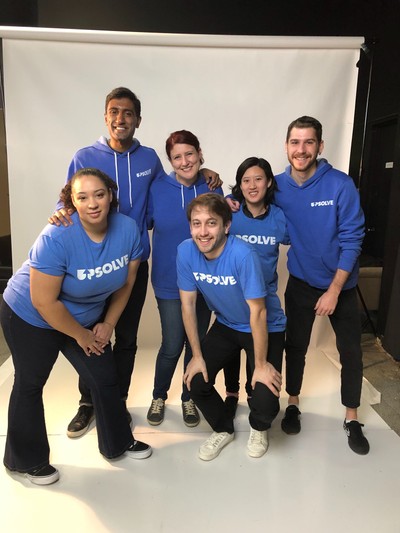
I joined Upsolve because I wanted to build something with real impact at scale, and I came to see bankruptcy as one of the most powerful (and overlooked) tools for economic mobility. We’ve recently crossed over $1 billion in debt discharged. It’s been incredibly meaningful to be part of work that translates so directly into real-world mobility and stability.Claire Robinson with the team at UpsolveClaire Robinson
Shannon: What core values drive your work and how do you ensure those values are built into Upsolve’s products?
Claire: At the core of my work is a belief in empowerment. Most people are capable of navigating complex systems — the problem is that those systems are rarely designed to be understandable. At Upsolve, we build with the assumption that if we do our job well, someone shouldn’t need a lawyer just to complete a legal process.
When someone comes to Upsolve, they’re usually in one of the most stressful moments of their life. They’re dealing with debt, fear, and uncertainty. I believe our job is to meet them with clarity instead of complexity. Bankruptcy is technical, but confusion is not inevitable. Good design can make the next step feel manageable.
We build these values into our products by staying extremely close to users. We treat every support request as product feedback. If someone has to email us to finish a step, we assume we didn’t explain it well enough or design it clearly enough. Getting stuck isn’t a user failure — it’s a signal that we need to remove friction. Even as CPO, I still spend time replying to support tickets and completing document reviews. There’s no substitute for hearing directly from users and seeing, in practice, where the experience breaks down.
Shannon: Big picture, where do you see opportunities for AI to continue improving access to justice?
Claire: AI tools are already powerful in helping people find information. We’ve seen many impactful prototypes for tools that provide legal information that would have otherwise been hard to find or hard to understand. But most people’s access to justice legal problems don’t arise just because they can’t find information. The problem is often that the legal process itself is overwhelming — too many steps, too much technical language, too many small points of friction. A missing document, a confusing instruction, or a moment of uncertainty can lead to someone giving up.
I see the real opportunity for AI as not just as a smarter search engine, but as a navigation layer across complex systems. Instead of expecting people to decode institutions on their own, we can build tools that help them move through those systems step by step, reducing friction in the moments that typically cause people to stall.